>
>
Transforming Uncertainty into Confidence in Product Development

Uncertainties are inevitable when addressing a customer's need or solving a problem. If untested, these uncertainties can significantly risk your product's success. This article explores these uncertainties and their associated risks and provides a logical approach to testing methods. You can confidently navigate product development complexities by understanding and addressing these uncertainties.

uncertainty

Conceptual and Functional Uncertainty

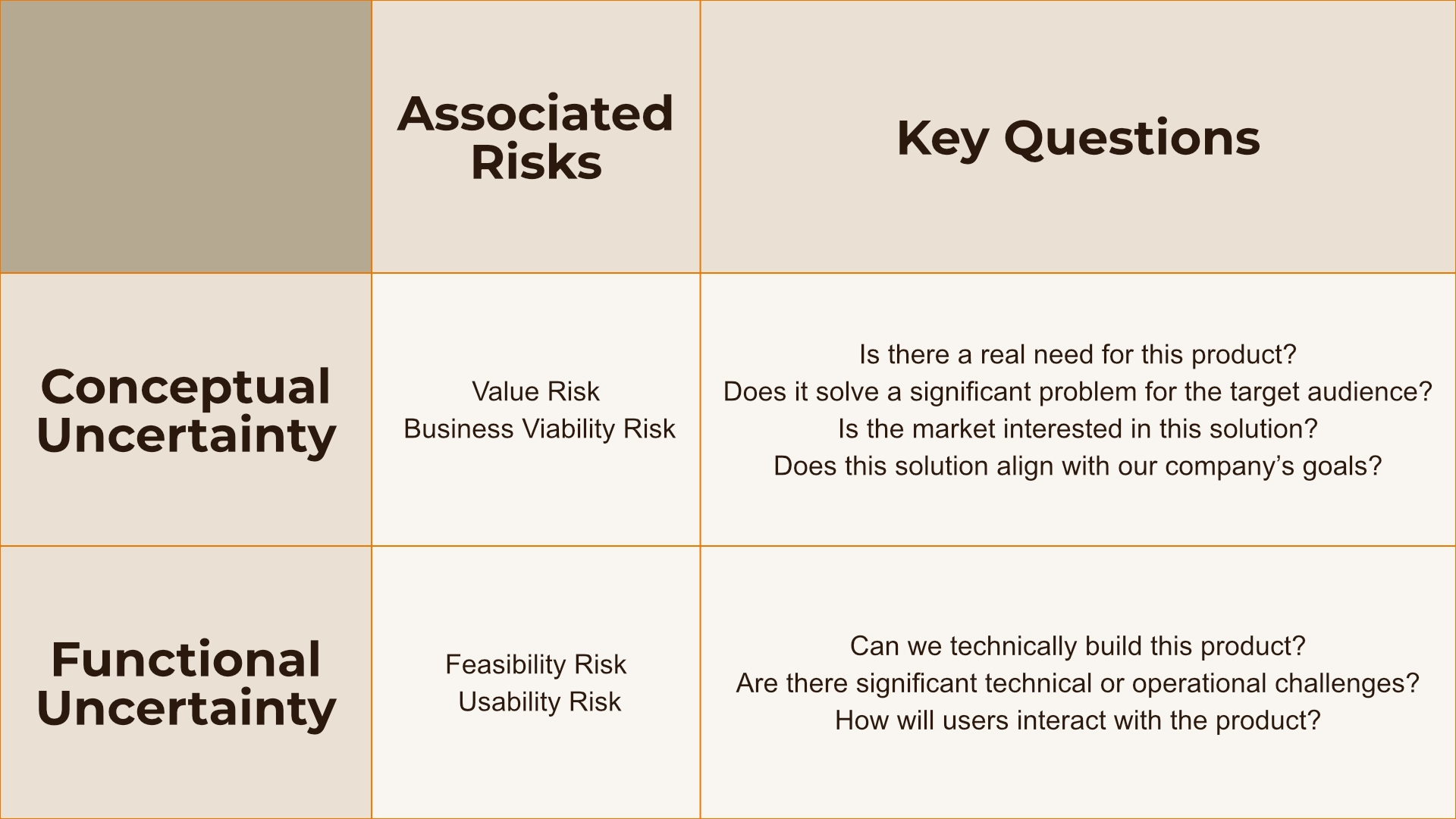
The initial focus when developing a product is on its viability. You need to determine if the product addresses a real need, solves a significant problem for your target audience, interests the market, and aligns with your company’s goals. All your questions and doubts in this phase fall under Conceptual Uncertainty.

As you gather feedback and validate the concept, another uncertainty emerges: Can you build the product as envisioned? This involves assessing technical feasibility, operational challenges, and user interactions. Every uncertainty here is related to the Functional Uncertainty.

In the early stage, you concentrate on Conceptual Uncertainty, validating your idea. Once this is under control, you address Functional Uncertainty, ensuring the product works as intended and offers a good user experience. What are you risking if you don't address these uncertainties?


The risks of not addressing your uncertainties

Marty Cagan addresses the most intuitive risks. He identified four primary risks that every product faces:

  1. Value risk (whether customers will buy it or users will choose to use it)
  2. Usability risk (whether users can figure out how to use it)
  3. Feasibility risk (whether our engineers can build what we need with the time, skills and technology we have)
  4. Business viability risk (whether this solution also works for the various aspects of our business)

Let's connect these risks to the uncertainties we feel during product development:


Transforming Uncertainty into Confidence through Testing

It is time to act now that we understand the uncertainties and risks we must mitigate. These uncertainties are present throughout your product development process, so you must test continuously while moving from conceptual to functional uncertainty to launch the product confidently.

Let's explore how to test these uncertainties and how to prevent these risks during your development process. I divided this into three arbitrary stages.


Early Stage

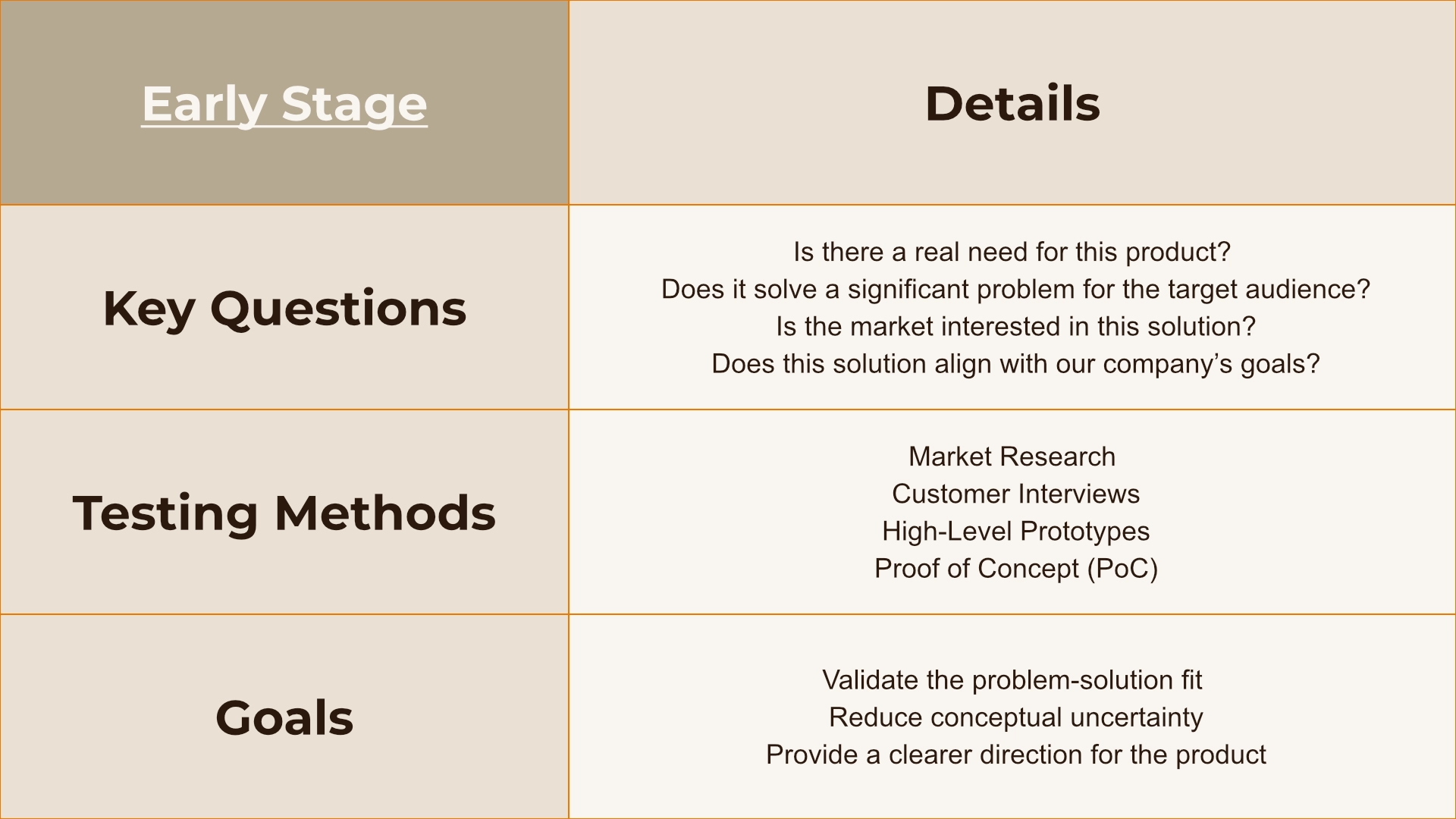
In the early stage of product development, the focus is on addressing Conceptual Uncertainty. This involves determining whether your product idea is viable and solves a significant problem for your target audience. Gathering extensive feedback is crucial to validate your concept and ensure a real market need.


Mid-Stage

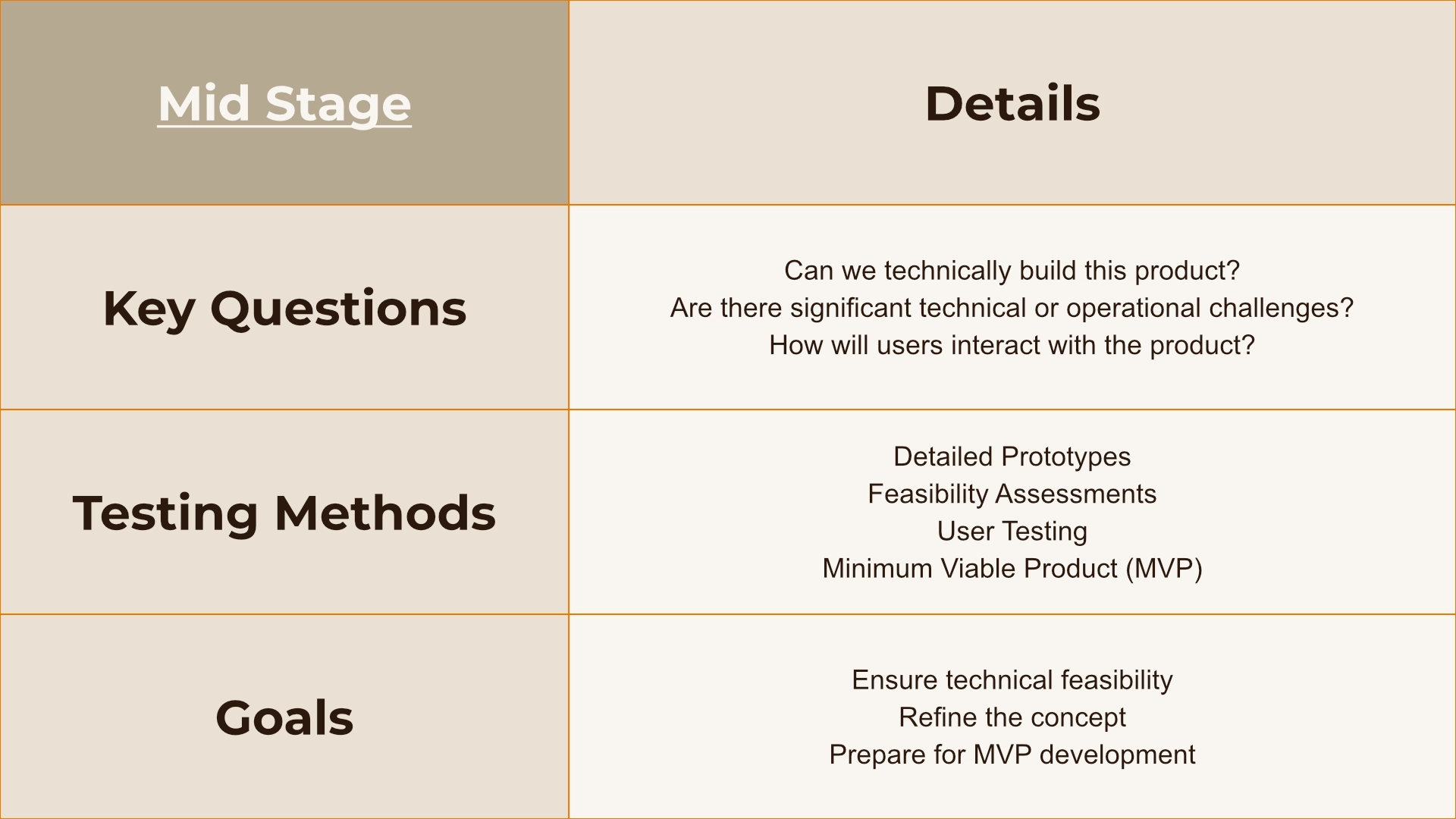
In the mid-stage, the focus shifts more towards Functional Uncertainty. This stage involves evaluating the product's technical feasibility and understanding user interactions. It requires assessing operational challenges and refining user interactions through detailed testing.


Late Stage

In the late stage, the focus is almost entirely on Functional Uncertainty. The goal is to ensure the product performs reliably, meets user expectations, and can scale to meet demand. This involves extensive testing and iteration to fine-tune the product.
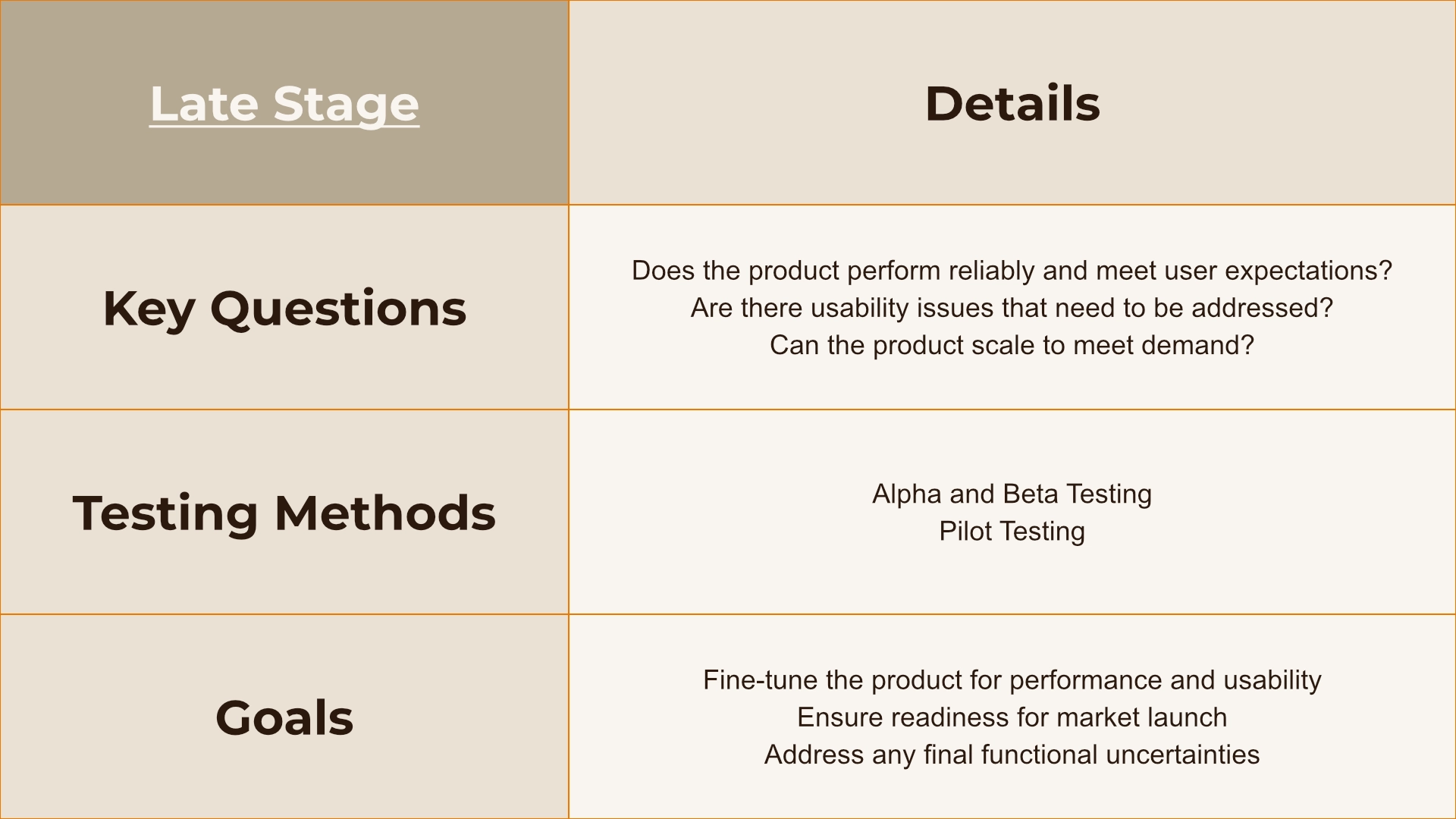


If you bring both uncertainties together with the most common testing methods, you get this overview.
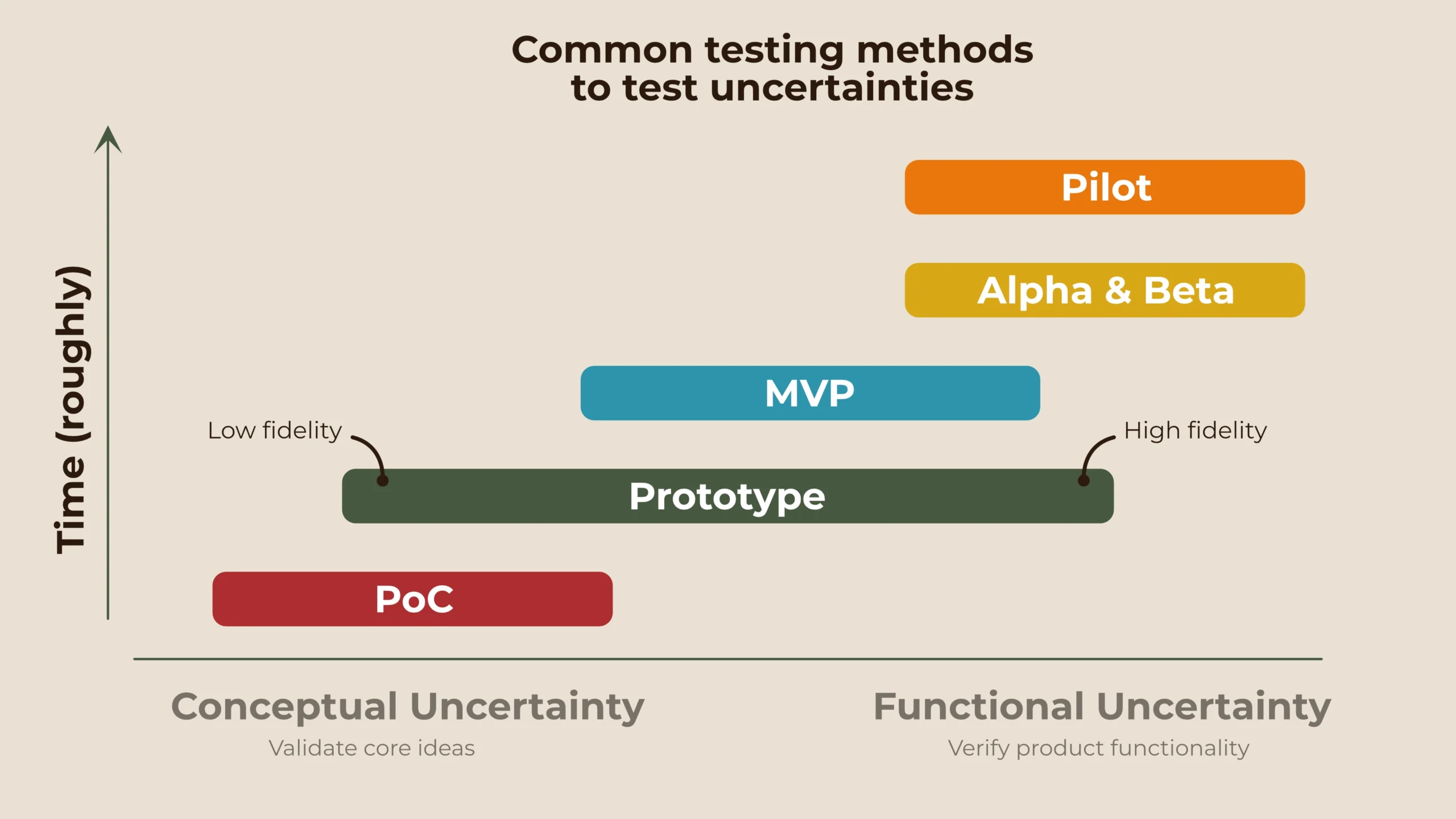
 

Conceptual functional uncertainty with testing methods


Conclusion and practical tips

The goal is not to follow this or any article to the letter. It’s about understanding the mindset of uncertainty, identifying risks, and testing them. You and your team can adapt and succeed by grasping these building blocks. Here is a list of practical tips.


Understanding and Explaining Uncertainty

  • Understand the basic building blocks of your uncertainties and the importance of testing. Explain them clearly.
  • Make this mindset part of you. Avoid jargon and other people's opinions. If you can explain this to someone without product knowledge and they understand, you're good.
  • If you hear an inner voice asking, "Is this going to work?" don’t ignore it. Find the smallest effort to test it.
  • If you never hear an inner voice asking, "Is this going to work?" write it on the wall as a reminder!


Team Integration and Ownership

  • Integrate this process into the team. Everyone on the team makes assumptions and should test them.
  • Encourage open communication and feedback to identify and address uncertainties.
  • Allocate time for the team to discuss potential uncertainties and risks.
  • Encourage team members to own the process of identifying and testing their assumptions.


Culture and Mindset

  • Foster a culture of continuous improvement and learning. Promote curiosity and questioning rather than assuming things will work.
  • Think about avoided risks rather than failed tests. You tested because you thought it would work, and it didn’t. Well done, risk mitigated!
  • Create a safe environment for expressing doubts and uncertainties.
  • Share testing experiences and insights within the broader organization.


Tools and Methodologies

  • Stay updated on new testing tools and methodologies that could benefit your process.
  • Provide training and resources to improve team testing skills.
  • Keep testing efforts lean and focused on the most critical uncertainties.
  • Document testing efforts and make them accessible for future reference.
  • Create templates and checklists to streamline the testing process.


Flexibility and Adaptability

  • Stay flexible and pivot based on testing results and new information.
  • Ensure testing is a critical part of the product development process, not an afterthought.

FAQ

Testing is crucial because it helps identify and mitigate uncertainties and risks. It ensures the product is viable, feasible, and user-friendly before launch.

Conceptual uncertainty can be addressed through market research, customer interviews, high-level prototypes, and proof of concept (PoC) to validate the problem-solution fit and reduce uncertainty.

Functional uncertainty can be addressed through detailed prototypes, feasibility assessments, user testing, and developing a minimum viable product (MVP) to ensure technical feasibility and refine the concept.

  • Is there a real need for this product?
  • Does it solve a significant problem for the target audience?
  • Is the market interested in this solution?
  • Does this solution align with our company’s goals?
  • Can we technically build this product?
  • Are there significant technical or operational challenges?
  • How will users interact with the product?
  • Does the product perform reliably and meet user expectations?
  • Are there usability issues that need to be addressed?
  • Can the product scale to meet demand?

Table of Contents

Recommended Books & Articles

LeanStartup
The Lean Startup
"The Lean Startup" introduces a methodology for building businesses and launching products, emphasising experimentation, validated learning, and agility.
INSPIRED-2D
Inspired
"Inspired" offers insights on creating beloved technology products. Cagan provides strategies for structuring effective product teams and processes that drive innovation and business success.