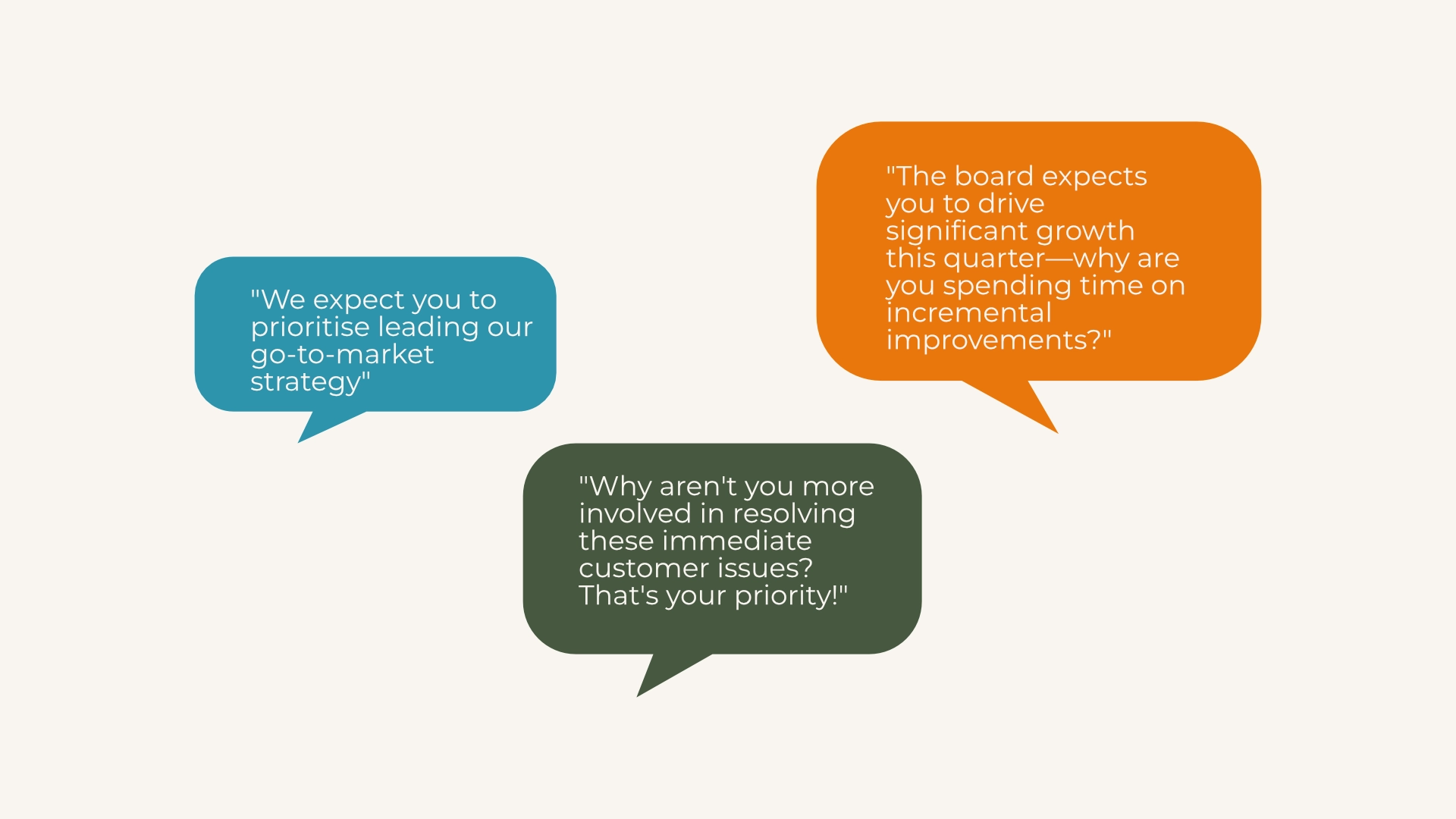
Challenge 1: Ambiguous Role Expectations
Ambiguity in role expectations is a common challenge for Product Managers. You might receive conflicting instructions about your responsibilities, leading to confusion and frustration. For example, while your direct manager expects you to focus on strategic road mapping, a different team might pressure you for immediate customer support solutions.
Action Points:
- Clarify Responsibilities
- Prepare Effectively: Before meeting with your manager, create a focused list of questions concerning your responsibilities, decision-making authority, and key deliverables.
- Hold a Strategic Discussion: In a one-on-one meeting, discuss these areas to gain clear and actionable insights into your role. For instance, ask specific questions like, "Am I expected to lead customer engagement directly, or should I delegate this to the team?"
- Summarise Key Points: After the meeting, concisely summarise your clarified responsibilities and share them with your manager for confirmation. This document should be brief and focused, used primarily as a reference to ensure alignment.
- Streamline Documentation
- Create a Quick Reference Guide: Instead of detailed documents, develop a simple one-page guide that outlines your key responsibilities and expected outcomes. Share this guide with your team to align expectations without overwhelming anyone with details.
- Update as Needed: Briefly review and adjust this guide during regular check-ins or as your role evolves, keeping it relevant and valuable.
- Implementation ideas
- Scenario-Based Planning: If tasked with product development and client relations, describe how much time to allocate to each responsibility and identify your goal for each area.
Feedback Integration: Regularly seek and incorporate feedback on how your role impacts team performance. Based on this input, adjust your focus, such as increasing attention on areas where team members need more direct support.

Challenge 2: Conflicting Stakeholder Demands
As a Product Manager, you often find yourself at the intersection of conflicting demands from various stakeholders. For instance, while the sales team might push for new features to attract clients, the engineering team could emphasise the importance of stability and bug fixes. Balancing these needs without a clear strategy can lead to project delays and dissatisfaction among team members.
Action Points:
- Apply Prioritisation Frameworks
- MoSCoW Method: Utilise this method to classify stakeholder demands into 'Must have ', 'Should have ', 'Could have', and 'Won't have'. For example, if a feature request from the sales team aligns with the product's strategic goals and highly impacts revenue, it can be categorised as 'Must have'. Less critical enhancements suggested by other departments might fall into 'Could have'.
- RICE Scoring: To prioritise effectively, assign Reach, Impact, Confidence, and Effort scores to each demand. For instance, a new feature that could bring in many users but requires significant research might have a high Impact score but a lower Confidence score due to technical uncertainties.
- Develop Specific Solutions for Stakeholder Conflicts
- Conflict Resolution Workshops: Organise workshops where stakeholders can present their cases for different demands and collectively work towards a consensus. This can help understand the implications of each demand and the resources involved.
- Stakeholder Mapping: Identify and categorise stakeholders based on their influence and interest. This helps understand who to prioritise when conflicts arise and how to tailor communication to address their concerns.
- Enhance Stakeholder Management Techniques
- Engage in Proactive Communication: Establish a routine of proactive updates to keep all stakeholders informed about project statuses, decisions, and changes. This transparency helps in managing expectations and reduces conflicts.
- Negotiation and Mediation Skills: Develop your negotiation skills to handle demands effectively. When stakeholders have competing priorities, employ mediation techniques to find a middle ground that aligns with the product's strategic goals.
- Feedback Loops: Implement a structured feedback loop where stakeholders can see how their input has been incorporated or why certain decisions were made. This will build trust and reduce friction over time.
Challenge 3: Reactive Tasks vs. Proactive Strategy
In the fast-paced role of a Product Manager, it's easy to constantly address urgent daily issues, from sudden customer complaints to urgent bug fixes. This reactive mode prevents strategic thinking, leading to burnout and stunted product growth.
Action Points:
- Shift Focus to Proactive Planning
- Dedicated Strategy Time: Block out regular weekly time slots solely for strategic planning. Treat these blocks as non-negotiable appointments on your calendar, similar to important meetings. This dedicated time should be used for activities like reviewing market trends, exploring new opportunities, and setting long-term goals. Don't forget to involve the right people in these meetings.
- Use Strategic Planning Tools: Incorporate tools such as SWOT analysis or the Blue Ocean Strategy during your planning sessions to identify opportunities and threats and to differentiate your product from competitors. Document the outcomes and revisit them regularly to adjust your strategies based on new insights or changes in the market.
- Develop Long-term Planning Techniques
- Roadmap Development: Create a visual roadmap that outlines key milestones and strategic goals for the next 6 to 12 months. This roadmap should align with the company's overall objectives and be accessible to all team members to ensure everyone understands the long-term direction.
- Scenario Planning: Engage in scenario planning sessions where you and your team can forecast different future scenarios and develop strategies to address them. This helps prepare for potential market changes and ensures your strategies are adaptable.
- Detail Implementation Steps for Proactive Planning
- Establish Clear Objectives: For each strategic session, set specific objectives and desired outcomes. For example, one session might focus on identifying key growth drivers, while another might tackle potential new markets for expansion.
- Communicate and Collaborate: Share the insights and strategies developed during planning sessions with your team and key stakeholders. Seek their input to refine these strategies and ensure alignment across the organisation.
- Monitor and Adapt: Set up a regular review cycle to assess the effectiveness of your strategic plans. Use key performance indicators (KPIs) to track progress and make adjustments as necessary. This iterative process ensures that your strategies remain relevant and impactful.
Challenge 4: Emotional Toll of the Job
The role of a Product Manager is demanding in terms of workload and emotionally taxing. Balancing the high expectations of stakeholders, navigating team dynamics, and constantly shifting priorities can significantly affect one's mental health and overall well-being.
Action Points:
- Tailored Stress Management Strategies
- Daily Decompression Rituals: Integrate short, structured activities into your day that allow you to decompress. This could be a 10-minute walk after important meetings, a brief meditation session using an app like Headspace, or journaling to reflect on the day's achievements and setbacks.
- Emergency Stress Protocols: Develop a set of immediate actions to take when feeling overwhelmed, such as stepping away from the work environment, having a predefined person to talk to about your stress, or engaging in a physical activity that helps release tension
- Cultivate a Supportive Company Culture
- Advocate for Mental Health Resources: Work with HR to enhance or introduce mental health resources and policies. This could involve organising workshops on stress management, providing subscriptions to mental health apps, or establishing a confidential counselling service.
- Promote an Open Dialogue about Stress: To destigmatise stress and well-being issues, encourage discussions about them in team meetings. Share your experiences and challenges to open the conversation and foster a more supportive environment.
- Personalised Solutions for Diverse Roles
- Role-Specific Support Groups: Create or join support groups specific to Product Management. These groups can offer role-relevant advice, share coping mechanisms, and provide a forum for discussing unique challenges.
- Customisable Stress Relief Plans: Develop a stress relief plan that can be customised based on individual needs and the specific nature of their role. This plan could include options for flexible work hours, role-specific training to handle job pressures better, and regular check-ins with a mentor or coach.

Challenge 5: Overwhelming Time Constraints
As a Product Manager, the sheer volume of tasks, from overseeing product launches to coordinating with stakeholders, can often feel unmanageable. Managing these responsibilities efficiently without pressure requires effective time management and prioritisation strategies.
Action Points:
- Advanced Task Prioritisation Techniques
- Impact vs Effort Analysis: Assess each task's impact and required effort. Prioritise tasks with a high impact but requiring low effort to maximise productivity and outcomes. For instance, if updating a feature significantly enhances user satisfaction with minimal development effort, it could be prioritised.
- ABC Priority System: Classify tasks into three categories: A (must be done today), B (should be done this week), and C (nice to do but can wait). This system helps distinguish between urgent tasks and those that can be deferred.
- Deepening Delegation Strategies
- Identify Delegation Candidates: Analyse your team's strengths and project needs to match tasks with the right team members. For example, technical tasks can be delegated to those with the necessary expertise, and soft-skill tasks like stakeholder communication can be assigned to those who excel in interpersonal relations.
- Provide Clear Instructions and Expectations: When delegating, be clear about the task outcomes, deadlines, and the extent of the team member's authority.
- Offer Support and Feedback: Be available to discuss concerns and provide guidance. Regular check-ins ensure that delegated tasks are on track and team members feel supported.
- Implementation examples
- Daily Top Three: Each morning, identify the top three tasks that must be completed by the end of the day. This will focus your energy on critical items and ensure progress in key areas.
- Weekly Review Sessions: Hold weekly reviews to assess what was accomplished, what wasn’t, and why. This helps refine your prioritisation strategy and improve future task management.
Challenge 6: Internal Politics
Navigating the web of internal politics is critical for any Product Manager. Internal politics often involve navigating power struggles, aligning conflicting agendas, and managing hidden motives, which can complicate decision-making and project progression. The goal is not to play political games but to understand them and find a way for politics not to get in the way.
Action Points:
- Understanding and Navigating Organisational Dynamics
- Map the Political Landscape: Create a stakeholder map that identifies key players, their influence levels, and their interrelations within the organisation. This map will help you understand the power dynamics and strategise your interactions.
- Engage in Cross-Departmental Networking: Regularly interact with members from different departments to build a broader understanding of the organisational culture and goals. This can provide insights into how different groups operate and what they value, which is crucial for navigating internal politics.
- Practical Examples of Political Navigation
- Scenario-Based Strategy Development: If a project is stalled due to conflicting departmental goals, arrange a mediation session where all parties can openly discuss their concerns and seek a compromise. Demonstrate how aligning the project with the company's objectives can serve everyone's interests.
- Leverage Informal Leaders: Identify and ally with informal leaders who can influence opinion and decisions. For instance, if a respected senior engineer is sceptical about a new feature, work closely with them to understand their concerns and adjust your approach based on their feedback, thus gaining their support.
- Enhanced Focus on Communication
- Transparent Decision-Making: Whenever possible, make the decision-making process as transparent as you can. Share the reasons behind your decisions and their benefits to various stakeholders. For example, if prioritising a particular feature over another, explain the rationale regarding data-driven outcomes, customer feedback, and alignment with strategic goals.
- Consistent Updates and Feedback Loops: Maintain regular communication with all stakeholders to keep them informed and involved. Establish feedback loops where stakeholders can express their views and concerns, which helps preempt potential political issues and ensures that your decisions are well-informed.
Conclusion
Navigating a Product Manager's multifaceted role demands a keen understanding of product management techniques and an adeptness at handling interpersonal dynamics. Today's challenges are opportunities to strengthen your leadership and strategic skills for tomorrow.
Embrace Continuous Improvement: Recognise that each challenge is a stepping stone towards mastering your role. Commit to continuous learning and improvement, enhancing your technical skills, deepening your market knowledge, or refining your interpersonal abilities.
Set Long-Term Goals: Define your career objectives for the coming year and the next five years. Identify the skills and experiences you need to achieve these goals, and actively seek opportunities that align with them. For instance, if your long-term goal is to lead a product division, consider roles or projects that allow you to develop skills in strategic planning and cross-functional leadership.
Cultivate Resilience and Adaptability: In your journey, resilience will be as crucial as your technical skills. Embrace flexibility in your strategies and openness in your thought process to adapt to the rapidly changing business environments.
Call to Action: Select one area you've struggled with recently, like managing stakeholder expectations, prioritising tasks, or balancing your work-life commitments. Apply the specific strategies discussed to address these challenges. Document your progress and reflect on what strategies are working and where adjustments are needed.
As you continue to grow in your role, remember that the path to success is iterative and dynamic. Each challenge faced, and each obstacle overcomes not only enhances your capabilities but also sharpens your vision as a Product Manager.